Care providers are being asked to do more with less. Demand is rising as Australia’s population ages, regulation is tightening under the new Aged Care Act, and workforce shortages mean fewer people are being asked to shoulder more work. Layered on top of all this is a problem that rarely gets discussed from a vendor’s perspective: most providers are running a different system for every setting, every function and every part of the person’s care journey.
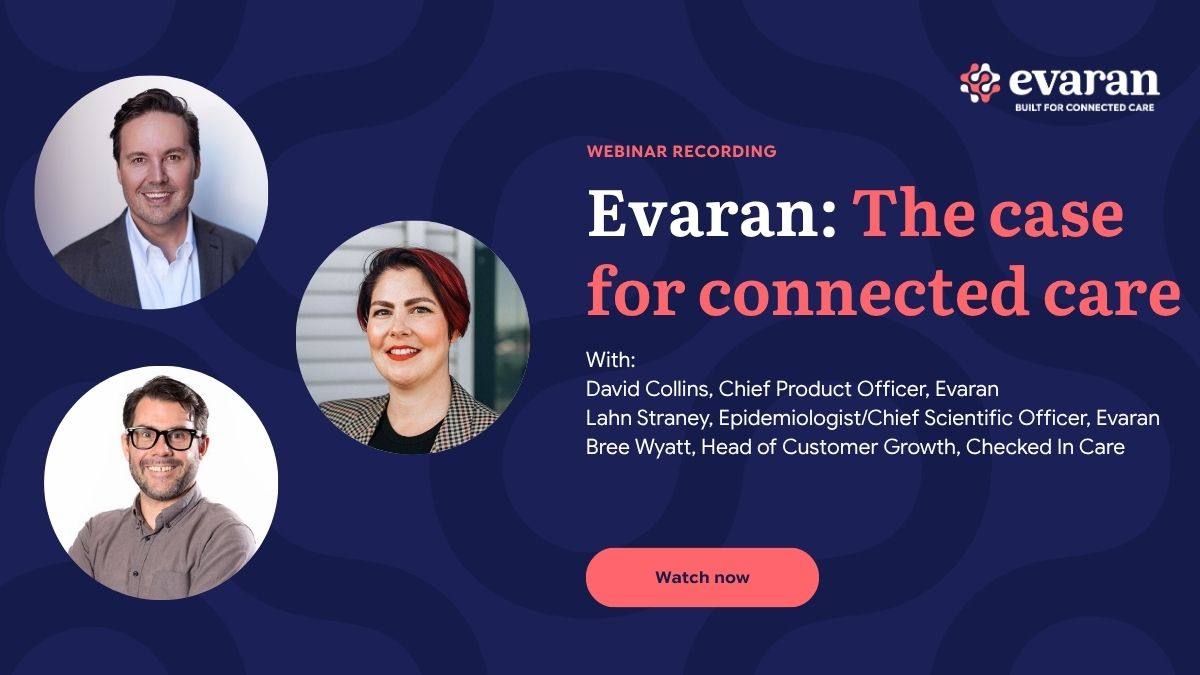
That fragmentation was the starting point for a recent Evaran webinar, where Bree Wyatt (Head of Customer Growth, Checked In Care) sat down with David Collins (Chief Product Officer) and Lahn Straney (Chief Scientific Officer) to talk through what connected care means in practice, and why Evaran was built to solve for it.
What is Evaran
Evaran brings together five platforms, each representing a different part of the care sector: eCase, an established enterprise and resident management platform, Unity, which supports regional, allied health and community providers, MOA, a market leader in quality and governance, Checked In Care, which provides a window across each platform along with self-service and higher everyday living functionality, and Evaran Home Care (also known as CareLineLive), the group’s home care and workforce management brand.
Together, these brands support over 1,000 care providers across Australia, New Zealand, the UK, Europe and North America, spanning home care, residential care, retirement living, disability and community settings. That scale, combined with over 170 employees and a strong Australia and New Zealand presence, is what allows Evaran to invest in a genuinely joined-up platform rather than a loose collection of products.
Three pressures, one platform
David Collins set out three compounding challenges facing providers today. First, demand: Australia’s over-75 population is growing faster than any other age group, and people are moving through multiple care settings over time, often losing continuity of information at exactly the point it matters most. Second, regulation: the Aged Care Act has shifted the sector to a rights-based model with stronger quality standards, meaning providers now have to continuously prove good care, not just deliver it. Third, workforce: there simply aren’t enough care workers, and the ones in post are losing hours to double entry, chasing information from external parties and reconciling records.
Evaran’s answer is a connected care record sitting at the centre of the platform, with home care, retirement living and residential aged care settings feeding into and drawing from that single record. Specialist modules, covering clinical care, medication management, care planning, documentation and billing, feed evidence into the record as care happens rather than reconstructing it at audit time, while an interoperability layer connects the platform to external data sources like pharmacies, GPs and My Health Record.
Crucially, providers don’t need to adopt every module to benefit. As David put it, the platform is designed so that each module a provider does use feeds more information into the connected care record, and that’s where the real value compounds.
Why connected data matters
Lahn Straney brought the scientific perspective, and one example he shared cuts to the heart of the problem: weight loss. It’s an outcome every provider tracks, but the causes can sit in entirely disconnected systems, from poor-fitting dentures picked up in an oral health audit, to dietary dissatisfaction logged in a complaints system, to food wastage recorded in catering. Bringing that data together turns what’s currently a treasure hunt into a much faster route to insight.
The same logic applies to incidents. An operational response and a governance reporting obligation both follow a fall, but they’re often managed by separate teams. A connected system means the front-end capture of that incident can trigger both workflows immediately, rather than relying on manual handoffs, which matters when reportable incidents carry strict notification windows.
Evaran’s approach to AI
Rather than starting with the technology, Evaran is starting with the problem. Lahn described the group’s AI strategy as a five-point spectrum:
- Data capture – making it easier for staff to record rich information via voice and conversational tools
- Data quality and standardisation
- Insights – surfacing information people wouldn’t otherwise notice
- Decision support
- Active care planning
Evaran is currently focused on the first three.
Several projects are already in pilot, including AI-assisted audit interviews that test staff comprehension and log the results automatically, conversational survey and assessment collection, and meal recommendations that factor in dietary needs, texture requirements and cultural preferences. David confirmed several of these are on track to reach customers within the next three to six months, following in-house and provider-led beta testing, with ethics approval built into any pilot involving vulnerable people.
On the use of AI in clinical decision-making, both speakers were clear about where the line sits. As Lahn put it, decisions should stay with the clinician: AI’s role is to serve up insights and information that support more informed decisions, not to make the decisions itself.
Where connected care is heading
Asked where they’d like the connected care record to be in three years, David pointed to a continued focus on reducing administrative burden so more time goes back to care rather than admin. Lahn’s answer was more foundational: a standard data taxonomy and a clean, agreed data warehouse across the sector, which he sees as the real unlock for prediction and understanding the impact of care practices on outcomes.
Both were candid that Evaran is still early in this journey, but with a next-generation home care product and further AI capability due over the coming months, it’s a journey with real momentum behind it.
Watch the full webinar recording